Dashboard Filter > Presets & Interconnected Filters
Learn how to add preset values to Draxlr dashboard filters, manually or from a saved query, and link filters so a city list depends on the selected country.
Filter Presets let you predefine filter values that users can quickly select from a dropdown.
This makes filtering dashboards faster and more consistent, especially when working with common or repetitive filter values (like countries, employee IDs, or product categories).
Benefits of Using Presets
- Speed: Quickly filter dashboards without typing values.
- Consistency: Ensure all users apply the same standard filter values.
- Flexibility: Add as many presets as needed for common cases.
Types of Presets
Steps to Add Saved Query Presets
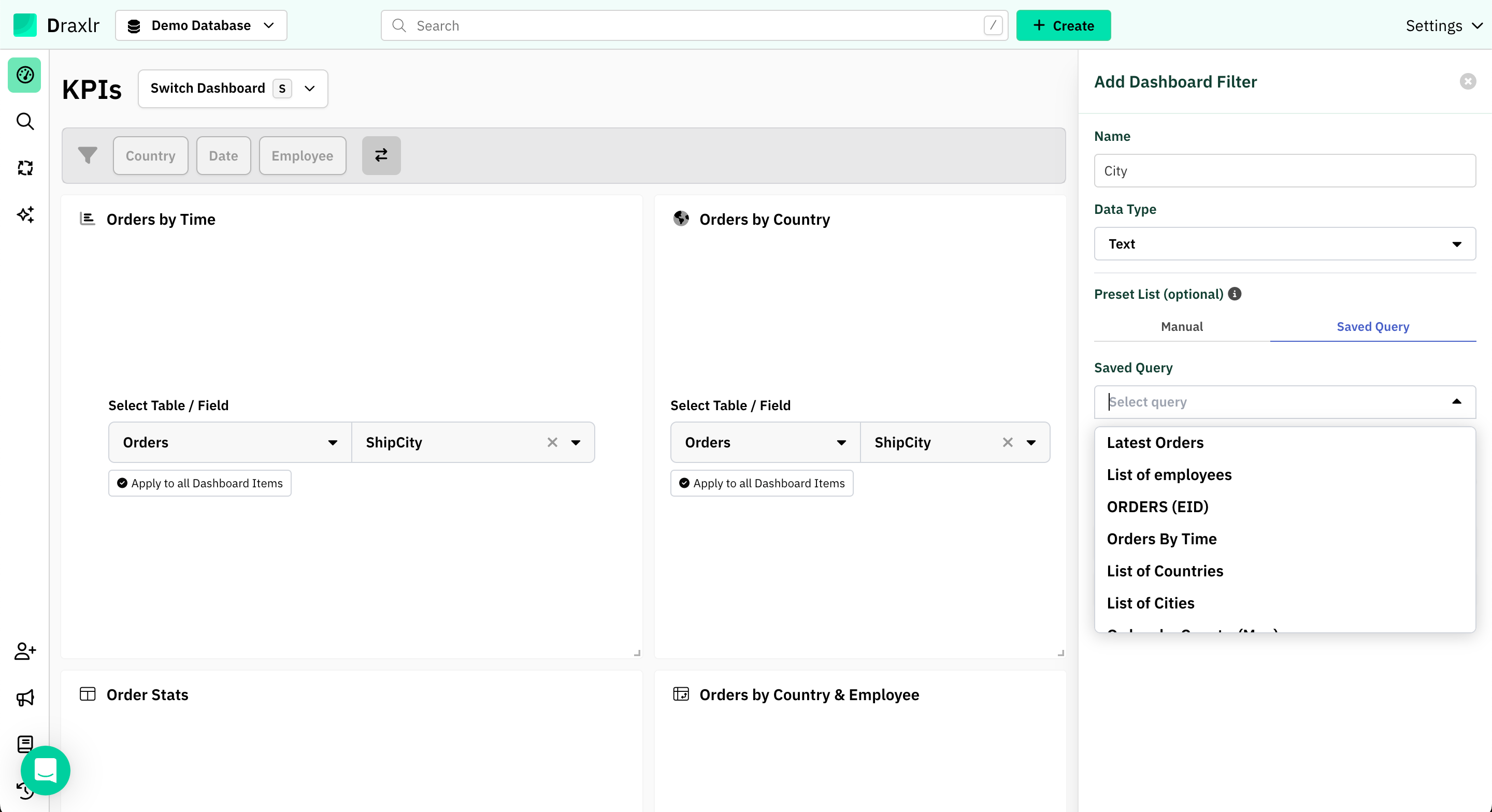
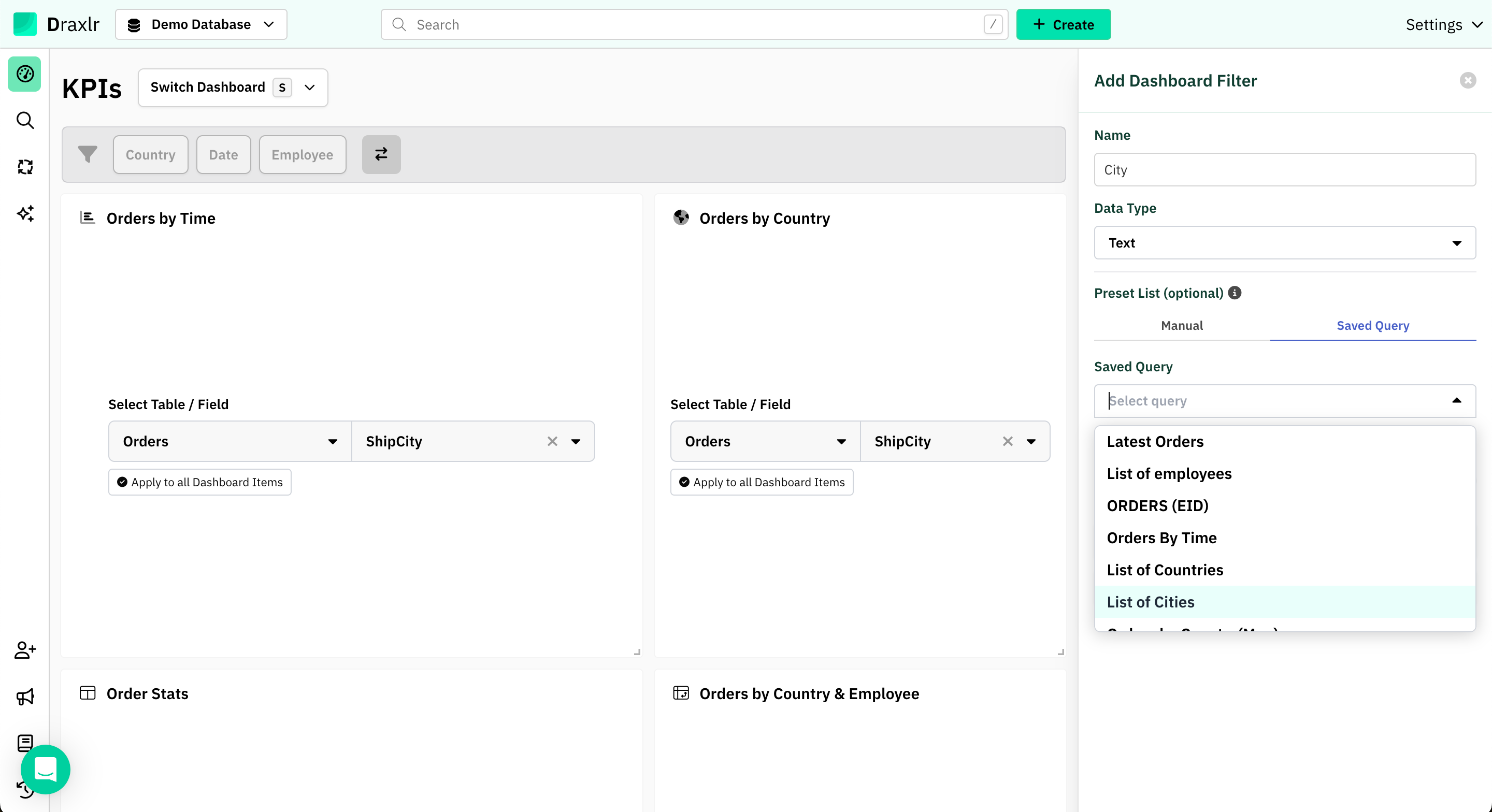
Click on the Saved Query tab to see a list of saved queries.
1. Open the Filter Settings
Open the dashboard and click on the filter you want to update or create a new filter.
Navigate to the Update Filter section on the right panel.
2. Select Saved Query Tab
In the Preset values (optional) section, switch from Manual to Saved Query.
This displays a dropdown list of available saved queries.
3. Choose a Saved Query
Select a saved query that returns filtered values.
For example, you can use a query that returns a unique list of cities for the "City" filter.
4. Map Label and Value Fields
Choose which fields from the saved query will be used as:
- Label Field → what the user sees (e.g., City Name)
- Value Field → what the system uses internally (e.g., City ID)
You’ll also see a preview of the presets that will appear in the filter.
5. Enable Interconnected Filter (Optional)
If you want this filter to depend on another filter (e.g., City depends on Country), turn on Interconnected Filter.
Example: When a country is selected, only cities within that country will appear in the City filter. See Interconnected Filters for how the child filter behaves when the parent changes.
6. Select the Parent Filter
Choose the parent filter that will control the current filter.
For example, select Country as the parent for the City filter.
7. Define the Parent Field Mapping
Choose where the parent filter's value is applied in the saved query:
- Table and column → for example, map Orders.ShipCountry so cities are filtered by the selected country.
- Raw query variable → if the saved query is Raw SQL with variables, pick the variable (for example,
{{country}}) that receives the parent filter's value.
Optionally, turn on Auto-select single option to apply the value automatically when only one option remains.
8. Save the Filter
Click Update to save your filter with the saved query presets.
9. Use the Presets
Now, the filter presets will appear dynamically in the filter dropdown.
For example, when a user selects USA in the Country filter, the City filter will only show cities from the USA.
Benefits of Saved Query Presets
- Dynamic population of filter values.
- Supports hierarchical (interconnected) filters.
Interconnected Filters
An interconnected filter is a child filter whose dropdown depends on the value of another parent filter. For example, with Country as the parent and City as the child, choosing France in Country limits the City dropdown to cities in France.
Interconnected filters require Saved Query presets on the child filter, and the dashboard needs at least one other filter to act as the parent.
Set Up an Interconnected Filter
Open the child filter
Click the filter that should depend on another filter (for example, City) and choose Edit, or create a new filter.
Use Saved Query presets
Under Dropdown List, switch to Saved Query and select a query that returns the child's values, such as a list of cities with their country.
Turn on Interconnected Filter
Turn on Interconnected Filter and select the Parent filter (for example, Country).
Choose where the parent value is applied
The parent filter's value narrows down the child's saved query:
- For a Query Builder saved query, pick the table and column to filter on (for example, the
countrycolumn). - For a Raw SQL saved query with variables, pick the variable that receives the parent's value (for example,
{{country}}).
Optionally turn on Auto-select single option
When this is on and the parent's value leaves only one option in the child, that option is selected and applied automatically.
Save the filter
Click Update (or Create for a new filter).
What Happens When the Parent Filter Changes
- The child's dropdown is narrowed. The child only lists values that match the parent's current value. When the parent has no value, the child lists all of its values.
- Values that no longer apply are removed. If the child has a selection that isn't in the new list, it is removed automatically. When several values are selected, only the ones that no longer apply are removed.
- A single remaining option is selected (when Auto-select single option is on). For example, choosing Iceland in Country selects Reykjavik in City if it is the only city in Iceland.
- The dashboard refreshes once. The parent and the updated child filter are applied together.
- Chains update in order. If the child is itself the parent of another filter (for example, Country → City → Store), each level updates in turn.
- Pre-applied parent values count too. If a public URL or an embedded dashboard pre-applies the parent filter, the child is updated the same way when the dashboard opens.
| Parent (Country) changes to | Child (City) before | Child (City) after |
|---|---|---|
| Iceland (one city) | No selection | Reykjavik, with Auto-select single option on |
| France (several cities) | Reykjavik | Cleared, since Reykjavik isn't in France |
| USA (several cities) | New York | New York, unchanged because it's still available |
Hidden filters in embedded dashboards and public URLs:
In an embedded dashboard or a public URL, a hidden filter with a pre-applied value is never changed automatically, even when its parent filter changes. A hidden filter without a pre-applied value is still updated when its parent changes, and is cleared when its parent filter is cleared.
Tip:
Use interconnected filters for hierarchies such as Country → State → City, or Category → Sub-category → Product, so viewers can only pick combinations that exist in your data.